
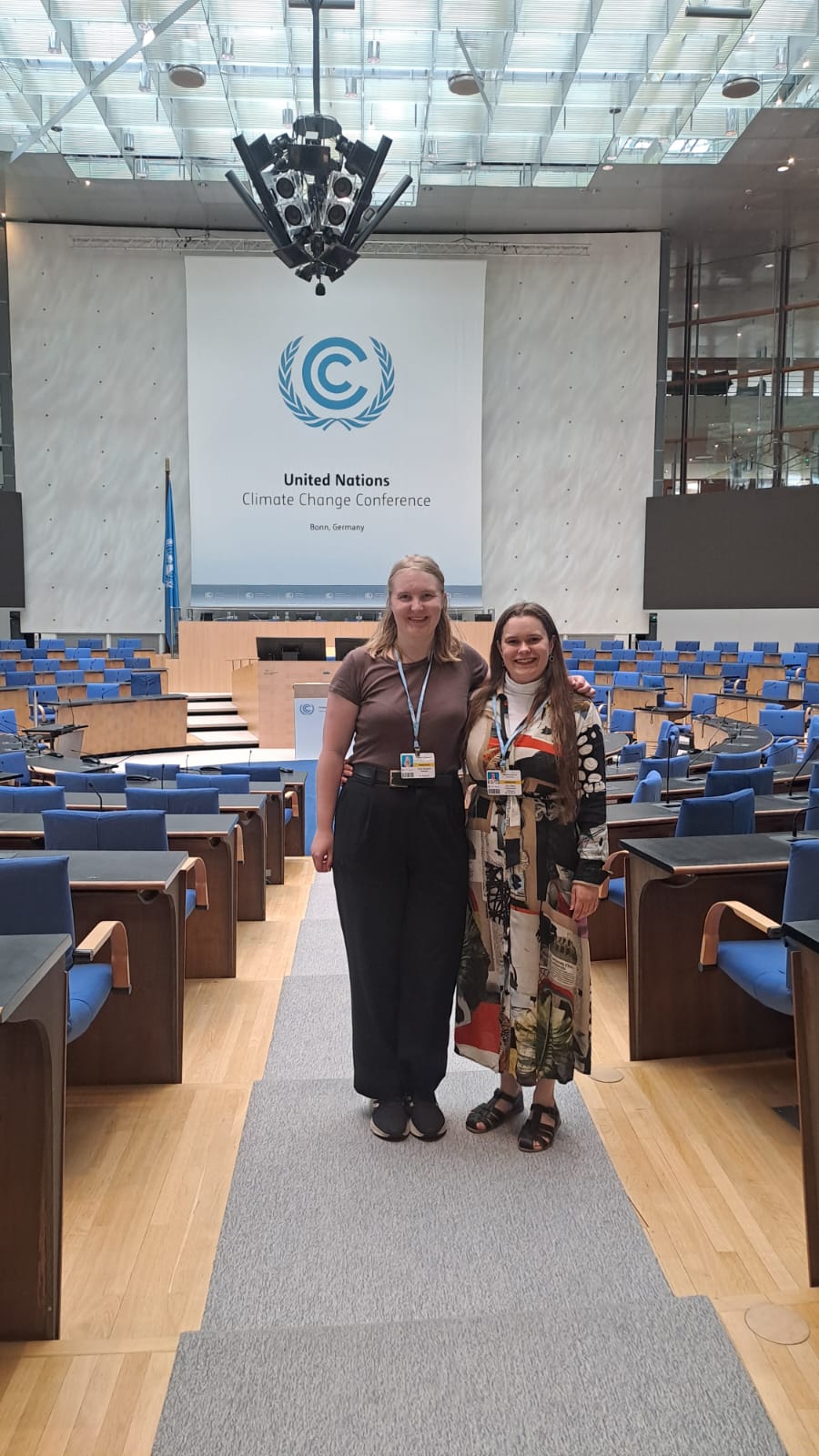
I mitten av juni samlas världens länder i Bonn för klimatförhandlingar. Mötet är en del av de årliga förhandlingarna inom FN:s klimatkonvention, som kulminerar i ett klimattoppmöte i slutet av hösten, i år COP30 i Brasilien. Act Svenska kyrkan deltog som observatör, representerade av två Ageravolontärer, Sofie Ohlsson och Elsa Grönbäck, samt Claes Hedström (Svenska kyrkan) och Margareta Koltai (Act Svenska kyrkan). Act Svenska kyrkan var del av den globala ekumeniska delegationen som består av medlemmar från Kyrkornas Världsråd, ACT-Alliansen och Lutherska Världsförbundet.
Delegationen åkte besvikna hem. Men också stärkta i att vi som samfund har en viktig roll för att påverka beslutsfattarna att ta klimatnödläget på allvar. Vi behöver också vara en röst för rättvisa och en hållbar omställning där vi brukar resurser inom Skapelsens gränser.
Ageravolontärerna deltog i arbetet med att ta fram YOUNGO:s (den officiella barn- och ungdomskretsen inom FN:s ramkonvention om klimatförändringar (UNFCCC)) uttalande vid mötets slut. Den del som framfördes av Sofie kan du läsa här nedan:
”Coming to Gender, SBI 18, let’s start with the good news: We have a text! Even two.
Bad news: with last minute footnotes, reducing gender to sexes, sliding back on agreed language, and gender rooms favorite activity: brackets. Most crucial items are bracketed, or not in the text at all, so for example intersectionality or diversity. (Det som står inom hakparentes diskuteras fortfarande och risken att det ändras eller tas bort är stor).
This is not only saddening, but severely concerning. It’s an established fact that the climate crisis is deepening existing inequalities and disproportionately impacting those who are already marginalized: Children, youth, women, and gender-diverse people – especially those who are Black, Indigenous, disabled, LGBTQIA+, or from the Global South.
As YOUNGO’s Women & Gender Working Group, we demand that gender justice be embedded across the UNFCCC framework – starting with an ambitious GAP (Gender Action Plan), strengthened Gender Mechanism, and extending across all negotiation tracks.
Parties must guarantee that all UNFCCC processes adopt an intersectional, inclusive approach that goes beyond binary gender categories to reflect this diversity and specific vulnerabilities.
And, explicitly integrate sexual and reproductive health and rights (SRHR), as well as gender-based violence (GBV) into all climate negotiations and frameworks, recognizing their critical connection to climate justice and the protection of bodily autonomy and safety. Negotiating about our rights, or rather, if we should have rights, is cynical.
Parties must ensure that there is dedicated and accessible financing for women, girls and gender-diverse people in line with article 9.1 of the Paris agreement. This needs to reflect grassroot efforts for climate action, recognition, compensation and redistribution of care work, and robust safeguarding of education and training of women and girls in all their diversities to ensure a just transition within and between countries. We also call for the inclusion of high impact financing for education, training and the production of age-, disability- and gender-disaggregated data on women’s needs in climate policy, capacity-building for economic empowerment, and technology transfers.
Overall, we urge Parties to ensure that the GAP reflects the lived reality of girls, women and gender-diverse people globally in this climate crisis and adopts gender-transformative approaches, rooted in human rights, gender justice, and intergenerational equity.”
Kommentera det här inlägget